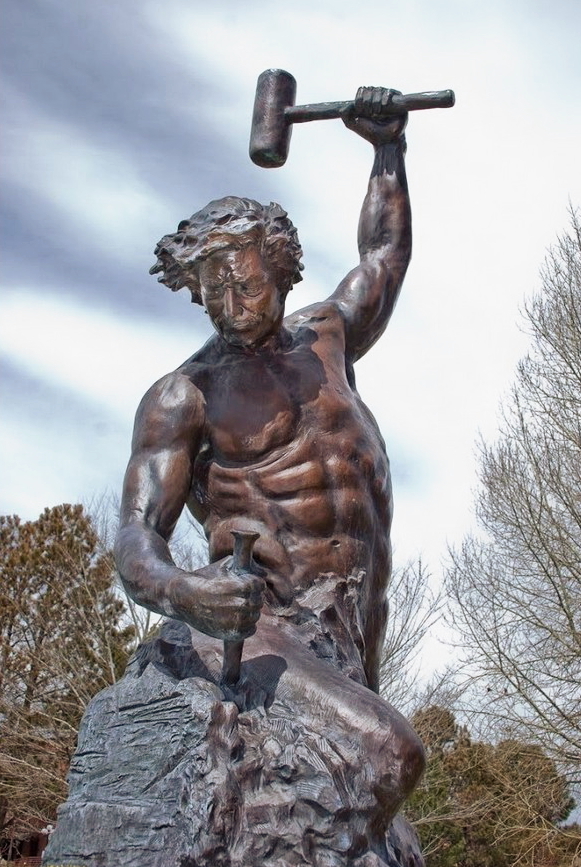
Due to the internet, we are quite readily exposed to art of all kinds, and thus artists of all kinds. From this has anyone else taken notice that many artists of our Modern age [2026] tend to be generally, if not very, interested in physical fitness? Let’s set aside the fact for a moment that obviously, as a consequence of modernity, we have greater knowledge of health and fitness in general. With that aside, even if many artists are not considered so “fit”, we as artists (and humans, to be honest) are pretty enthralled by human form. Most of us, when we depict the human body, love to embellish muscular mass and curvature. As someone who has worked in the sports and fitness field for years, as a Strength & Conditioning Coach and Nutritionist, as well as being a self-taught artist for over a decade, this is something that has stuck out to me more and more as the years press on. With this humble set of experiences on my end I have a few related points I’d like to weigh-in on this subject with, specifically its affecting qualities, in a way I have not seen discussed. Let’s dive in.
Before we get started into the main points of this article, I’d like to give a little background reference. We are now almost a couple generations into the 21st Century, and as such we have copious access to ancient and modern art-literally at our fingertips. From as early as the days of the Greeks, up to the Italian Renaissance and beyond, we have seen many quite aesthetic depictions of the human form, though mostly male until closer to modern times, which is due more to cultural and religious preference but still cannot be denied. And obviously there’s room for nuance here; it’s not likely that most of the artists of the ancient world were consciously making the human form a priority (that we know of), however the art can speak for itself. Over time, especially apparent in modern day, we have seen the steady to intense growth of it being one, however. Let’s look at a few examples to drive this point:


This starts, as with much of modern day culture, with the Greeks. Specifically with the depiction of their gods, they obviously put a high amount of effort into their skill to display such high quality detail of muscle. This subconsciously, and literally, put such aesthetics on a revered pedestal for all to see. These three examples of sculpture above clearly demonstrate this.


Next with the Renaissance, despite its very hard religious preference in culture, we still see such care to the detail of aesthetics in the human body, like with the “Creation of Adam” painting by Michelangelo. I believe Leonardo DaVinci, as he is basically the patron saint of the Italian Renaissance, was also a big driver of this, as he was a dedicated researcher of the human form. He would study cadavers, tirelessly copying, studying, and sketching various muscular anatomy (check Leo’s notebook for photo examples!). The “Vitruvian Man” drawing also leans into this concept with the implicit (nearly explicit) depicting of “divine proportion” within the human being (obviously, DaVinci was not referring specifically to fitness with this piece, but his fervor and study of the human anatomy was more than a stepping stone for such learning we have now). Artists like these two legends, and many others set the foundation for such a perspective.


As we reach modern times, specifically what we consider “post-modern” (1970s and onwards), we see the rise of comic books as a newly embraced and more democratized expression of art – compared to the previous religious monopoly on art and its uses. At this point is when we really get to see this admiration of aesthetics become most apparent and purposeful . It is no coincidence that by this time the practice of Bodybuilding had been rising in popularity and culture, both as a competitive sport and a hobby. The concept of physical fitness being almost completely under the influence of personal will, was bubbling to the surface throughout the Western world. However, it is necessary to note that many other cultures to the East already had established concepts and practices that revealed this as well, especially in Asia, and these were beginning to assimilate into the West as well.
To the far left in the pictures above, we see the Incredible Hulk (one of the most popular comic series during the start of Marvel). This is most obvious glorification of muscular aesthetics, despite it being enhanced to an almost grotesque level. This is also the time in which we began to depict women in greater aesthetic light as well, as shown with the Wonder Woman artwork next to it. These specific examples are more modern than the 70s, but the point still applies in principle; as far as art has related to time and society, we’ve gradually grown more infatuated with human muscular anatomy and how it looks.


Speaking of the East, the discussion of comic books cannot ignore the inclusion of “Manga” (Japanese style comic books). This style was introduced long before the U.S. era of Action Comics, Detective Comics, and Marvel. However, Mangas, which inspired the hyper aesthetic style of Japanese animation and are universally popular today, are known as “Shonen” manga (meaning for young men). The official Shonen Jump magazine launched in the summer of 1968, with other big names like Shueisha and Kodansha right on their tail. Right around that same 70-80s period which we see this new emergence of perspective on the Human body, all around the world. Granted, the U.S. did seem to be the pioneers of this perspective taken to an extreme in the examples of Super Heroes. Thus the defining characteristic of this new perception, became super-abilities, of which Japan was neck-and-neck with the US, with titles like Dragon Ball Z. No matter where in the world you went, “Comic books” were starting to be synonymous with “super powers,” or some extreme level of physical ability. By the 90s even Mangas followed suit, with the premiering of Sailor Moon (again, this perspective was applied early to women as well).
All of these events and “movements” of art history, along with many other influential artists, connections, and discoveries have implicitly and explicitly nudged the collective opinion of human anatomy and strength toward the direction in which we find ourselves today. Although there is definitely still very much to learn concerning human strength and physical potential, I’d like to had a perspective that will be helpful as far as individual understanding and use of these principles, much like in our normal lessons.
This very brief artistic history was by no means the only cause for this advent of a new perspective on human anatomy, there are countless other factors that had their own effect. However, this is a good point of reference as a foundation for applying such a perspective to our goals here. So let’s dive in now below, to look at the path of how we have come so near to the conclusion that the Art process is not only something we apply to our world, but to ourselves, through fitness, unexpectedly.
THE VISUAL TRINITY

Before we fully jump into this subject. Let’s add just a bit more context to the overall discussion. So we must address the concept of beauty, specifically as it applies to Art. From an artist’s perspective beauty is not subjective, but interpretive. This is because there are specific measurable and experiential aspects of the Visual World, and beauty is largely visual. When most hear the word “beauty” they typically begin to think from the modern perspective, which applies to fashion. But Art, by nature, is not fashionable. While it may start or influence trends, it does not follow them; therefore we must trash that understanding of beauty in order to achieve our goals here, or anywhere as artists in general.
So, if beauty in art is not actually about fashion, then what is it about exactly? I am of the opinion that beauty is, at its essence, a trinity. There are many things in this world that individual aspects of this trinity do apply to, but when they come together each at certain level of balance they will always result in beauty. The trinity of beauty is this:
- Form – This encompasses shape, silhouette, and size.
- Complexity – This encompasses depth, perspective, and layering (the relationship between the Forms)
- Precision – This encompasses the consistency of Mathematical accuracy, within the Complexity of Forms.
Now, does something have to be beautiful to be Art? No. As we discussed in a previous post, there are very specific elements present when someone is truly experiencing Art. However, this experience is typically much easier to produce with beauty, depending ultimately on the art/artist, of course. The trinity of beauty is a subject we will absolutely go into more thoroughly in the near future. For now, however, this will be a good starting point for our subject today.
THE INVISIBLE PATH

The main point I’d really like to get across here is that Art has a foundational path and a process. Though the aspects of this path are pretty specific, their application is extremely flexible (this is where creativity is actually applied). This process however, is mostly invisible, while only its effects are tangible. Fitness actually works similarly, but because fitness is mostly tangible (physical), while also personal and mental, it is an excellent and fundamental introduction to the journey of this unseen path. With a little better understanding of fitness’ connection to beauty and Art, we can now dive deeper into the subject.
Just as mentioned above in the trinity of beauty, fully experiencing and understanding Fitness relies heavily on perception of these same aspects as well. Which is why it is such a great introduction! Additionally, just as with the complexity in beauty and Art, the fitness path is made from, and develops in layers. There are four layers upward on this path of fitness, specifically.
LAYER 1: APPLICATION

This first layer is the MOST important in fitness and Art, which is why it is the start. If this is not done whole heartedly, there will be improvements left to waste, or worse, little to no improvement. Once one receives enough of an understanding of fitness, that same understanding must be applied to the best of the person’s knowledge and effort, as soon as possible. With no use, the knowledge will be quickly forgotten. (This understanding being general knowledge of how to exercise, eat, and rest properly, and that they are necessary for everyone; this info could come from coaches and others)
This application will initiate the first muscle to be built, but in the brain. This muscle is commitment, and without first its strength, none of the others can follow. Commitment will help us to stick it out when it seems change isn’t happening “fast enough.” A strong sense of commitment also comes from a respect for time, and knowing truly that we are at the mercy of its never ending cycle, and there are none above it. With this achieved, one will eventually begin to develop what we affectionately call “gains.” This is slang for visual evidence of your progress; it is visible change in body composition, typically muscle.
And with these gains, we develop something else, a new layer of awareness.
LAYER 2: AWARENESS

At this point we’ve begun to recognize our “gains;” the fat is melting away, the muscles begin to bulge and reshape the body in a way we like, and our performance and endurance during exercise is measurably improving as well. This is an amazing stage, as I like to say: the best motivation is progress. Even as the training increases in difficulty, if done properly, these gains may fluctuate or change but they never really stop. Again, this will create a new level of reality that you are now more acutely aware of; another layer of yourself that you’re beginning to unveil. Looking in the mirror now becomes more enjoyable. Why might this be (apart from the obvious reasons)?
Through looking at our reflection, we learn to perceive and be aware of the Form(s) that constitute ourselves and develop our own taste with them (forms which attract us the most). This can obviously turn bad, as anything can, when done improperly or in bad faith. However, your ability to think about how different you could appear is your mind’s practice of playing with Form, and it starts with the medium with which we are most intimate, ourselves. This phase in the process is very important, because many at this layer can succumb to the temptation of over-scrutinizing themselves. My opinion is that this typically happens if gains and progress come too quickly, and the individual has not internalized a true respect for the pace of time. This “respect” is called Delayed-Gratification; it is the understanding that the results of your actions can have a delay, and the better prepared one is for said delay, the better off they’ll be.
Regardless, one must stick through it, as this is both a final foundation in proper patience, and for the most important reason. This reason is Self-Efficacy. Efficacy, as defined by Webster, is “the ability to produce a desired result;” this is what the modern world defines as confidence. The point, however, is that confidence is a red-herring. Self-Efficacy is not a belief, like confidence, it is knowing that you can do what you’re setting out to do. This comes only with empirical evidence, the experience of doing it, or witnessing it. If you’re catching where I’m going with this, this is what makes layer 2 so important. Witnessing yourself developing the gains that you set out to make, adds another layer of evidence that you can do just that. This happens incidentally. It never was, and never will be necessary to purposefully work on your confidence. The only things you need in this part of the journey, are focus and patience.
This layer is the proof that you can make the things you desire into a reality. Once becoming aware of this power, over time your brain begins to wonder what else you can make real.
LAYER 3: COMPETENCY

If patience and commitment define the first and second layer of the process, this point is when Discipline becomes intuitive and internalized. Despite the typical understanding of the word, discipline, as it applies here, is not will-power; it is not the desire to continue when it becomes difficult, but the ability to do so. You cannot be disciplined where you are incompetent. For example: If someone is doing a difficult exercise, when they reach a point of exhaustion, if their technique (ability to perform the movement properly) is not up to standard, they will not only not be improving, but they run the risk of getting worse (through injury or other ways). Now, if the person performing this exercise was “disciplined” (in common understanding) they would keep going, when actually it would be best to switch that exercise for one where they can remain competent while challenged.
Discipline is about doing it well, as consistently as possible.
How does one get to a level to do continue doing something well, while under pressure or exhausted? The simple answer is repetition. Repetition, in my opinion, is a foundational building-block of reality. Without it, nothing would exist. As such, Exercises must be repeated, even if difficult, especially when difficult. My theory for why this might be the case is because of Time. Time itself is based in repetition; all parts of nature move through repeating cycles, every single thing. We are no different, so if we desire to improve we must follow the blueprint.
Either way, discipline itself then is a skill. As with all other skills, one must be patient and committed and the improvements will surely come. However, patience at this stage is also more readily and tangibly rewarded than in layer 1. For example, with understanding of the system of how reps and sets work together, one can manipulate their specific ratio to tweak the stimulus and gains achieved, and even the actual Time it takes to see those gains in some cases. This competence is obviously very applicable to our work on Art. Especially in the specific journey we are taking here. Reps and sets are the staple of our improvement, if you cannot repeat it, you cannot truly do it.
At this point we’ve internalized the universal skill of discipline, and it will unconsciously flow into the rest of our life. To reach a high level of competence, repeat it, and repeat it well.
LAYER 4: PROJECTION

Finally, at this layer in the process we’ve begun to hit our stride in our physical fitness and feel mentally and physically strong and competent! Once this happens is when what I call “projection” begins. This phase is when the fundamental aspects of the fitness process become fundamental to ourselves. They become how direct our daily lives, specifically in how we approach goals and problems, and as such is a lifestyle now. It’s important to note that this ability to project this process out into reality actually can start smaller and sooner, depending on the individual, possibly even at Layer 2. However, this last layer refers more to our use of it being so skilled that it is reflexive.
Let’s briefly go over each layer again and their related skills:
- Layer 1: APPLICATION – Skill of action and commitment developed.
- Layer 2: AWARENESS – Experience of progress, recognition of Form(s)
- Layer 3: COMPETENCY – Discipline & Delayed Gratification (respect for Time); application of reps/sets and skills
- Layer 4: PROJECTION – Lifestyle; implementation throughout life
As discussed, and shown directly above, each layer of this process has a skill which correlates directly to success in that layer. I want to make a clear point again that this path is the same for Art as it is for fitness.
The ability to commit, to sit down and act on a desire is a skill
The respect for Time, and ability to delay our gratification is a skill
The application of proper practice, reps, and sets (discipline), is a skill
The ability to project and apply these elements of ourselves out into or world, is the last and most important of these skills.

Again:
The ability to commit, to sit down, pick up our tool (pencil, pen, brush, etc.) is a skill
The respect for Time, and the acceptance that it will move while we work, is a skill
The application of proper practice, reps, and sets, the ability to keep coming back to hone and chip away at our focus, and to apply artistic skills properly over and over is a skill
These are the skills of the Art path. These are the skills of the fitness path. All skills are achievable, if practiced properly.
Fitness, by these metrics, is indeed an art form on its own. It gives you an experiential understanding of the foundations of Art, and the path one must take to reach a high level. This art form is applied to yourself, by projecting your understanding, desire, and imagination of Form(s) into the world, starting on yourself as the medium. By all standards of what makes something art, this means…